
Technical Engineering & Compliance Standards in CE-Certified Custom Blending
Custom blending is an indispensable core operation across modern manufacturing ecosystems—ranging from pharmaceutical processing, nutraceutical formulation, and cosmetic emulsification to polymer modification and high-throughput food production. Achieving high-performance batch homogeneity demands more than mechanical agitation; it requires rigorous fluid dynamics engineering, micro-dispersion control, thermodynamic management, and strict international regulatory compliance.
As a leading CE-certified original equipment manufacturer (OEM) and custom contract partner, our facilities adhere to the highest global design directives. The European CE Certification Mark verifies that equipment conforms to essential safety, health, and environmental protection requirements specified in the Machinery Directive (2006/42/EC), Low Voltage Directive (2014/35/EU), and Electromagnetic Compatibility Directive (2014/30/EU). For pressure-rated heating and vacuum blending vessels, compliance extends to ASME Section VIII Division 1 guidelines and the EU Pressure Equipment Directive (PED 2014/68/EU).
Information Gain Key Metric: Industrial mixing efficiency is directly governed by the non-dimensional Froude Number (Fr = N²D/g) and Reynolds Number (Re). Our custom-engineered ribbon and paddle blending systems optimize shear rate and bulk fluid flow to achieve a relative standard deviation (RSD) of less than 1.5% across heterogeneous solid-solid and liquid-solid mixtures.
Engineering Mechanics of Industrial Ribbon and Paddle Blenders
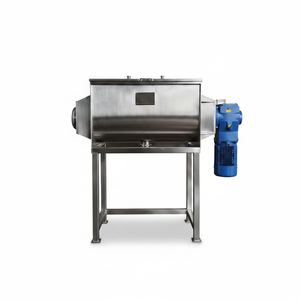
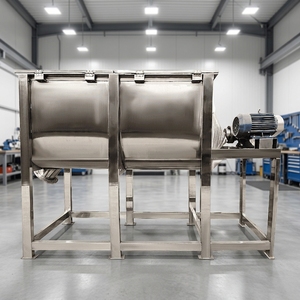
In dry powder blending, such as nutraceutical supplements, spice mixtures, and PVC calcium masterbatches, achieving uniform spatial distribution without particle degradation is critical. Industrial Ribbon Blenders (50 Cu. Ft to 1500L capacities) feature a double-helical outer and inner ribbon agitator setup. The outer ribbon moves materials toward the center discharge valve, while the inner ribbon forces material toward the outer ends, generating balanced counter-directional axial and radial flow patterns.
For fragile, abrasive, or heat-sensitive ingredients, our custom Paddle Mixers and Heated Cooling Units utilize contoured paddles positioned at precise attack angles. This minimizes friction-induced heat buildup while preventing particle shear, ensuring full batch integrity for delicate food seasoning powders, fine dyestuffs, and polymer composites.
| Blending Category | Primary Mechanism | Key Metallurgy & Finish | Compliance & Certifications |
|---|---|---|---|
| Food & Pharma Powder Mixers | Convective & Diffusion Double Helical Ribbon | SUS316L / SUS304 (Mirror Polish Ra < 0.4 µm) | CE, cGMP, Health Canada Licensed, FDA 21 CFR |
| High-Vacuum Emulsifying Tanks | Rotor-Stator High Shear & Anchor Agitation | Dual-Jacketed SS316L with PTFE Scrapers | CE, ASME Pressure Vessel, PED 2014/68/EU |
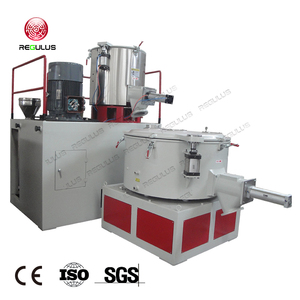
| Polymer & PVC Chemical Units | High-Speed Friction Heating & Fluidized Cooling | Abrasion-Resistant Alloy / Hard Chrome Plated | CE Machinery Directive, ATEX Dust Explosion-Proof |
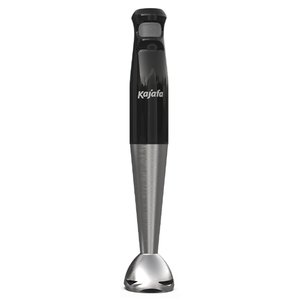
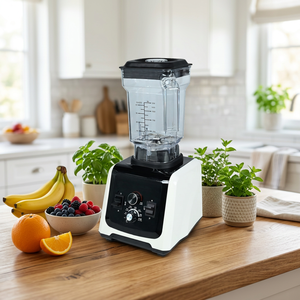
| Commercial Kitchen & Hand Appliances | High-Torque Immersion & Micro-Cut Blades | Food-Grade SUS Shaft & BPA-Free Tritan/PC | CE, RoHS, LFGB, UL Standards |
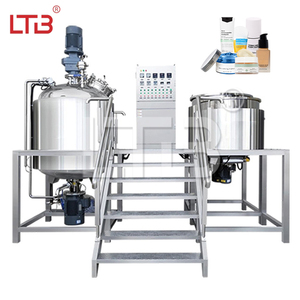
Cosmetic Vacuum Homogenization & Liquid Emulsification Systems
Liquid and semi-solid processing—such as skin creams, hair gels, cosmetic serums, and pharmaceutical emulsions—presents complex Rheological challenges. Simple mechanical stirring is insufficient to break down droplet sizes below the micron threshold. Our 1000L to 3000L Customized Vacuum Homogenizing Blending Tanks integrate three complementary mixing technologies:
- High-Shear Rotor-Stator Homogenizer: Rotates at speeds up to 3,600 RPM, subjecting liquids to intense hydraulic shear, cavitation, and micro-crushing to reduce particle size down to 0.2–2.0 microns.
- Center Anchor Agitator with PTFE Scrapers: Continuously sweeps the vessel interior walls to eliminate thermal boundary layers and prevent localized scorching or product buildup during heating and cooling cycles.
- Deaeration Vacuum Environment: Operates under full vacuum (-0.095 MPa) to strip micro-air bubbles from the liquid matrix, preventing cream oxidation, improving emulsion density, and significantly extending shelf life.
Enterprise Advantages & Quality Infrastructure
Drawing upon over 25 years of specialized OEM and contract manufacturing expertise, our facility operates strictly under a Health Canada site licence, ISO 22716 cosmetic GMP standards, and international ISO 9001 quality management systems. Buyers partnering with our group gain an uncompromised competitive edge across six foundational operational pillars:
Certified Compliance
Fully compliant with CE Machinery Directives, ASME pressure standards, and cGMP protocols. Every system is delivered with complete validation documentation (IQ/OQ/PQ) and material traceability certificates.
Single-Source Customization
From initial CAD modeling and finite element analysis (FEA) to motor sizing, blade design, electrical panel wiring, and surface finishing, all custom engineering is executed in-house.
Global Export Capability
With established distribution channels and export regulatory support in over 35 countries, we manage Certificate of Analysis (CoA), Certificate of Free Sale (CFS), and customs documentation seamlessly.
Future Procurement & Technology Trends in Industrial Blending (2025–2030)
The global processing machinery market is undergoing a seismic shift toward digital transformation, sustainability, and ultra-flexible manufacturing. Procurement officers, plant managers, and OEM buyers must align their equipment acquisition strategies with these emerging industry paradigms:
1. Smart Mixing & Industrial IoT (IIoT) Integration
Modern CE-certified blenders are rapidly evolving into intelligent data nodes. Integration of Process Analytical Technology (PAT)—including in-line Near-Infrared (NIR) spectroscopy sensors—allows operators to track blend uniformity in real-time without stopping the mixer or extracting manual samples. Predictive maintenance algorithms monitor bearing vibration, motor temperature, and seal integrity, preventing unplanned downtime.
2. Energy Efficiency & High-Torque Eco-Motors
Energy consumption represents a major operational expenditure over a blender's lifespan. Procurement mandates are shifting toward IE4 and IE5 super-premium efficiency motors paired with advanced Variable Frequency Drives (VFDs). VFD-controlled mixing dynamically adjusts torque curves based on fluid viscosity changes, cutting power usage by up to 30% during low-shear heating or cooling phases.
3. Hygienic Design & Automated Clean-In-Place (CIP/SIP)
To eliminate cross-contamination risks and minimize downtime between batch changes, blending tanks are increasingly designed in accordance with EHEDG (European Hygienic Engineering & Design Group) principles. Self-draining tank bottoms, crevice-free continuous seam welds, automatic retracting CIP spray balls, and validated Sterilization-In-Place (SIP) connections are becoming mandatory standard specifications across food, beverage, and cosmetic production lines.
4. Eco-Friendly Applicator & Appliance Materials
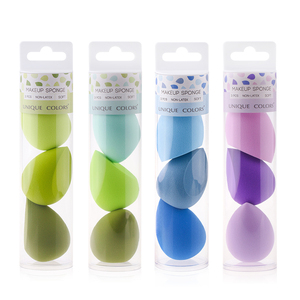
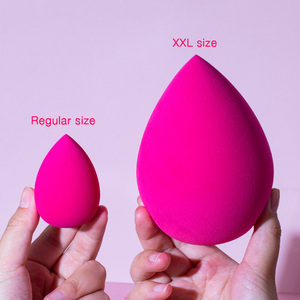
Beyond heavy industrial machinery, commercial and consumer blending tools—such as beauty makeup sponges, loose powder blenders, and handheld electric immersion shafts—are transitioning to eco-friendly, latex-free polyurethane matrices and recycled stainless steel components. Sustainable foam cell engineering optimizes liquid retention and product dispersion while satisfying strict environmental regulations.